
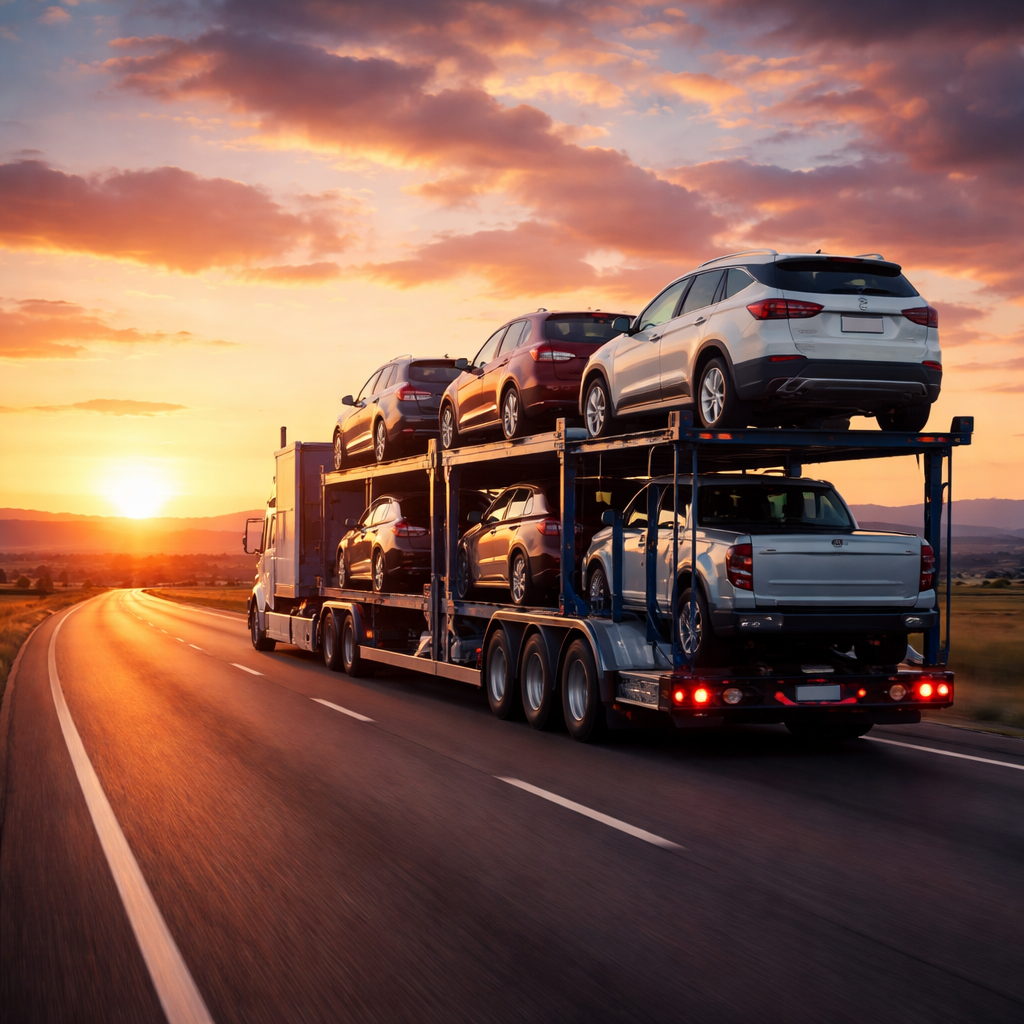
For most vehicles, open transport is the right choice. It costs significantly less, books faster, and exposes your car to roughly the same conditions it would face being driven the same distance. Enclosed transport is worth the premium in a narrower set of cases: vehicles worth more than about $70,000, classics and collectibles, cars with low ground clearance or custom paint and wraps, and winter routes through heavily salted roads. The honest way to decide is not to ask which service is "better," but whether your specific vehicle's replacement cost and irreplaceability justify paying roughly 40-60% more for a sealed trailer and higher cargo insurance limits.
The Real Difference Between Open and Enclosed Car Shipping
Both services do the same job: a licensed motor carrier loads your vehicle onto a trailer and delivers it to your door. The difference is the trailer, and everything that follows from it — capacity, cost, availability, and how much insurance the carrier keeps on the load.
How Open Carriers Work
An open carrier is the two-level, steel-framed trailer you see on every interstate. A full-size rig hauls 7-10 vehicles; smaller "hotshot" trailers carry 3-4 and reach tighter residential streets. Your car rides exposed to weather and road debris — exactly as it would if someone drove it the same route. This is not a budget compromise: it is how nearly every new car reaches its dealership from the factory or port.
Position on the trailer matters. Top-deck spots avoid fluid drips from vehicles above and sit farther from road spray. Some carriers charge a modest premium for a guaranteed top-load slot, and on a long haul that is usually money better spent than upgrading the entire shipment to enclosed.
How Enclosed Carriers Work
An enclosed trailer is a sealed box. Capacity drops to 2-7 vehicles, which is the root of the price difference: the same fuel, driver hours, and tolls divided among far fewer cars. Hard-side trailers are fully rigid and offer the most protection; soft-side (curtain-side) trailers use a reinforced fabric wall, cost less, and block weather and debris but are easier to breach.
Loading equipment is often the deciding factor. Many enclosed trailers carry hydraulic lift gates rather than ramps, the only practical way to load a vehicle with under roughly 4-5 inches of ground clearance without scraping the front splitter. If your car is lowered or is a non-runner, ask specifically for a lift-gate trailer.
Cost: What Each Option Actually Runs
Auto transport is a spot market. Rates move weekly with fuel prices, seasonal demand, and how many trucks are running your lane, so treat any figure as a range, not a quote. Useful anchors for open transport, door to door:
- Under 500 miles: roughly $0.75-$1.10 per mile; most short moves land at $350-$550
- 500-1,500 miles: roughly $0.50-$0.75 per mile, most often $500-$1,000
- 1,500-2,500 miles: roughly $0.40-$0.60 per mile
- Coast to coast (2,500-3,000 miles): commonly $1,000-$1,700 for a standard sedan
Enclosed transport typically adds 40-60% to those figures, and more on thin lanes. A cross-country move that runs $1,300 open often lands between $1,800 and $2,500 enclosed. Short regional enclosed moves rarely price below $700-$900, because a small rig still covers its fixed costs across two or three cars.
Four things move the number in either mode: vehicle size and weight (a three-row SUV or dually pickup can add $200-$400 over a compact sedan), whether the car runs and rolls (inoperable vehicles need a winch and typically add $150-$250), route density, and season. Snowbird lanes into Florida, Arizona, and Texas spike from roughly October through December and reverse in April and May, and rates on those corridors can jump 20-30% during the peak.
Transit Time and Pickup Windows
Once a car is loaded, transit time is nearly identical between the two modes — same roads, same federal hours-of-service limits on drivers. Plan on:
- Under 500 miles: 1-2 days
- 500-1,000 miles: 2-3 days
- 1,000-1,500 miles: 3-4 days
- 1,500-2,000 miles: 4-6 days
- 2,000+ miles: 6-10 days
The difference is the pickup window, not the drive. Open carriers are far more numerous, so a truck can usually be assigned within 1-5 days of your first available date. Enclosed capacity is a fraction of the fleet and concentrated on high-value corridors, so realistic enclosed pickup windows run 3-10 days — longer for rural origins. If you have a hard deadline, book enclosed two to three weeks out, or pay for expedited service with a guaranteed pickup date.
Insurance: The Difference That Matters Most
This is where the decision actually has teeth, and it is the part most comparisons skip. Every interstate motor carrier is required by the Federal Motor Carrier Safety Administration to maintain at least $750,000 in public liability coverage under 49 CFR 387.9. That figure protects other people and property — it is not coverage for your car. The relevant number is the carrier's cargo insurance, and it is not standardized.
In practice, open carriers commonly hold $100,000-$250,000 in cargo coverage spread across a load of 7-10 vehicles. Enclosed carriers typically hold $250,000 to $1,000,000 or more, and high-end operators often carry per-vehicle limits rather than a shared pool. If your car is worth $150,000 and shares a $250,000 policy with nine others, that math should worry you. Ask for the certificate of insurance before dispatch and confirm whether the cargo limit is per-vehicle or per-load.
Two other checks take five minutes. Verify the carrier's USDOT and MC numbers in the FMCSA's public SAFER database, and if you are booking through a broker, confirm they hold the $75,000 surety bond federal law has required of freight brokers since MAP-21. Olympic Auto Transport has arranged vehicle shipments for 15+ years, is licensed and bonded, and includes cargo insurance on every open transport and enclosed transport booking, door to door.
Whichever you choose, the Bill of Lading and condition report is the document that decides any claim. Photograph the car from all four corners plus the roof and wheels in good light before loading, confirm existing damage is noted, and repeat the inspection before signing at delivery. A signed clean delivery receipt is very hard to walk back.
The Real Benefits of Enclosed Auto Transport
Stripped of marketing language, enclosed gives you four things: no exposure to rain, hail, road salt, or stone chips; no public visibility of the vehicle; typically higher cargo insurance limits; and lift-gate loading for cars that cannot use a ramp.
Choose enclosed when your vehicle is a classic, antique, or restored car whose original paint cannot be replaced, an exotic or limited-production model, or a car with a show-quality finish, vinyl wrap, or soft top; when its value exceeds roughly $70,000; or when the route crosses the Northeast or Midwest in winter brine. Classic car transport is the clearest case: a chip in 40-year-old factory paint is not a body-shop repair, it is a permanent loss of value.
When Open Transport Is Clearly the Right Call
Open is the correct default for daily drivers, leases, standard SUVs and trucks, relocations, college moves, and dealer inventory. It is also the better choice when timing matters more than cosmetics, since the far larger carrier pool means fewer delays and more route options. If your car already lives outdoors, a few days on an open trailer changes nothing beyond a layer of road dust.
How to Decide in Two Minutes
- Price the repaint. If a professional respray or a stone-chip repair on your car would cost more than the enclosed premium, enclosed is rational. If it would cost less, open is.
- Check ground clearance. Under about 4 inches, you need a lift gate, which almost always means enclosed.
- Check season and route. Northern winter lanes and hail country tilt toward enclosed; most others do not.
- Check the cargo limit. If your vehicle's value approaches or exceeds the open carrier's per-load cargo coverage, upgrade.
- Get both numbers. The premium is often smaller than people expect on long hauls and larger than expected on short ones. Request a free auto transport quote priced both ways before deciding.
Frequently Asked Questions
How much more does enclosed auto transport cost than open?
Expect 40-60% more in most lanes. On a coast-to-coast move that is often a difference of $500-$900; on a short regional move the percentage gap is similar but the dollar gap is smaller. The premium widens on routes with little enclosed capacity and narrows on busy high-value corridors like Los Angeles to Miami or New York to Florida.
Is open car shipping safe for a normal vehicle?
Yes. Open carriers are how manufacturers deliver new cars to dealerships nationwide. Your vehicle is exposed to weather and road debris, but it is strapped down by a professional, covered by cargo insurance, and inspected at both ends. The realistic risk is cosmetic — road film, occasionally a small chip — not mechanical.
Can I put personal items in the car?
Carriers generally allow up to about 100 pounds in the trunk, below the window line, in either mode. More than that risks a surcharge or refusal at pickup, and personal belongings are almost never covered by cargo insurance. Remove toll transponders, garage remotes, and valuables before handoff.
Does enclosed transport arrive faster than open?
No. Drive time is the same because both are governed by identical federal hours-of-service rules. Enclosed shipments often take longer overall because the smaller enclosed fleet means a longer wait for a truck to be assigned to your route. If speed is the priority, open transport with a flexible pickup window is usually the fastest option.